Marshall the Pioneer Blog Series: Part 4
The First to Introduce Weighted Ball Training to Baseball Pitchers
Part 4 highlights Dr. Mike Marshall weighted ball training—decades ahead of mainstream adoption and scientific validation.
New to this Blog Series?
You can start from Part 1: Biomechanics or the Series Overview to explore other posts.
Dr. Mike Marshall Weighted Ball Training Origins
The Bullpen, The Iron Ball, and The Doubters
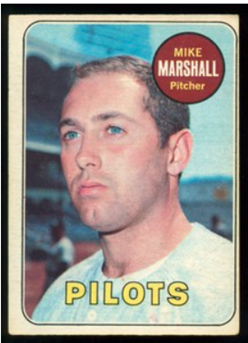
As far back as the mid-to-late 1960s, Marshall trained with weighted balls. Some labeled it as simply “weight training,” like lifting weights at the gym, but it was much more sophisticated and scientific.
Marshall wasn’t just building strength—he was building stability, muscular control, and proprioception. In fact, his methods were so unconventional that teammates like Jim Bouton took notice.
In his book Ball Four (1970), Jim Bouton described using the iron ball that Marshall kept in the bullpen during their 1969 season with the Seattle Pilots—marking one of the earliest documented instances of Marshall’s weighted ball training in professional baseball.
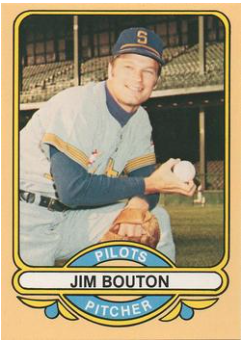
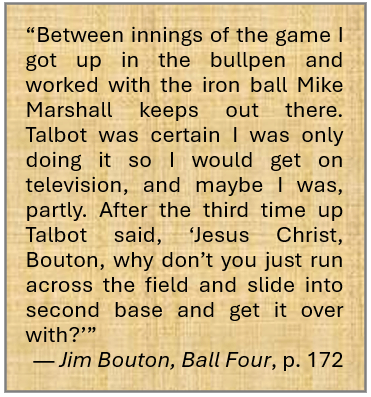
This quote and audio excerpt are presented for educational and historical purposes.
Fred Talbot, referenced in the quote, was a pitcher on the 1969 Seattle Pilots. His reaction captures how unconventional Marshall’s methods appeared—even to teammates. But Marshall’s use of weighted balls wasn’t performative—it was biomechanically intentional, rooted in his evolving understanding of kinesiology and pitcher health.
Baseball's Skepticism
Before weighted ball training became a standard method for velocity development, baseball viewed it with skepticism. Pitchers were told:
- Weighted balls were dangerous, leading to injury rather than preventing it.
- Traditional weightlifting was the only acceptable way to build arm strength.
- Heavy resistance ruins mechanics.
Marshall disagreed.
The Science Behind Dr Mike Marshall Weighted Ball Training
To Marshall, heavier throws demanded smarter mechanics.
Marshall’s weighted ball training program was about retraining how pitchers feel mechanics and manage workload. Heavier implements, applied with mechanical precision, helped correct inefficiencies in timing, posture, and arm action. As a result, Marshall’s foundation for weighted ball resistance became clear.
“My mioanglos* iron ball interval-training program increases the strength of these structures to withstand greater stress.” — Dr. Mike Marshall, Section IX: Interval-Training Program Drills, Part 04b: Training Facilitators – Iron Balls, in Chapter 36 of his online book.
* Mioanglos is a term Marshall coined by combining “mio” (muscle) and “anglos” (angular force).
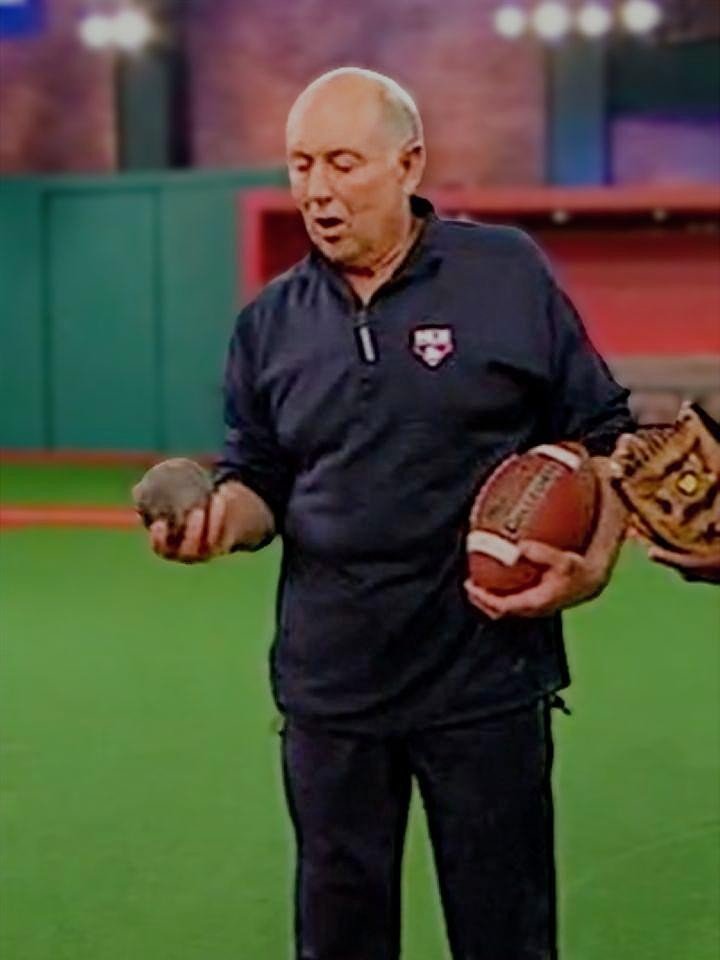
His routines emphasized grip strength and stress tolerance, starting with six-pound shot puts taped for secure handling. This gradual resistance and full-body sequencing—long before those terms were common in coaching circles—was designed to fortify the bones, ligaments, and tendons involved in accelerating the pitching arm.
Marshall's Foundations
Parts 1 through 3 of the Marshall the Pioneer 7-part blog series laid the groundwork.
Without Marshall’s foundational mechanics, muscle activation, and pronation safeguards, weighted resistance becomes just added stress—amplifying dysfunction instead of correcting it. These three components weren’t theoretical. Dr. Mike Marshall applied them directly through weighted ball training.
Part 1: Biomechanics
Marshall’s motion was engineered for physics, not feel. Iron ball drills reinforce trunk tilt, scapular rhythm, and full-body sequencing—correcting flaws through mechanical clarity.
Part 2: Kinesiology
Marshall’s routines activated forearm flexors, pronators, and stabilizers. Iron ball training amplifies these chains, teaching pitchers to withstand stress and throw safely.
Part 3: Pronation Mechanics
Marshall’s arm path neutralized torque through pronation-based release mechanics. Iron ball drills reinforce this safeguard, reducing injury risk from heavier throws.
Proprioception and Feedback
Where others saw danger or gimmick, Marshall saw a corrective tool rooted in physics and our body’s internal sense of position and movement without needing to look.
Want to see how proprioception works?
This diagram from Pinnacle Spine & Sports shows how receptors in muscles, joints, and tendons send feedback to the brain.
Dr. Mike Marshall’s drills enhanced proprioceptive awareness by training pitchers to refine arm paths through muscular feedback—not just repetition. This internal feedback loop helped athletes feel their mechanics and adjust in real time.
Marshall’s Integrated Philosophy
Marshall’s routines aren’t just about resistance. His drills build key muscle and reshape how pitchers move.
Key Takeaways from Dr. Mike Marshall’s Iron Ball Training Program
- Activates the full kinetic chain more efficiently
- Teaches controlled follow-through without elbow torque
- Reinforces arm paths through muscular feedback
- Trains pitching-specific muscles, unlike general weightlifting
- Enhances body awareness to refine movement through feel and feedback
- Uses gradual progression to prevent injury and protect joint integrity
Select the play icon to view Dr. Mike Marshall’s original instructional weighted ball training video.

Want to check out Dr. Marshall’s other instructional pitching videos? Click here
How Baseball Finally Accepted Weighted Ball Training
When Tradition Yielded to Science
Today, weighted ball training is a core component of many pitching programs—but its widespread use has been driven primarily by the pursuit of increased velocity. Companies aggressively market it, and influencers promote it as a shortcut to performance. Yet many biomechanists and sports medicine experts now raise concerns about injury risk when these tools are used without ensuring sound pitching mechanics.
Select each of the time period tabs below to view details from each era.
Dr. Mike Marshall Pioneered Weighted Ball Training for Baseball Pitching in the late 1960s
In 1970, Jim Bouton references Marshall’s iron ball in his book, Ball Four, marking one of the earliest published accounts of weighted balls in professional baseball pitching. At a time when baseball warned that weighted resistance would ruin mechanics or cause injury, Marshall used iron balls to safely improve pitching mechanics and performance.
Later, as noted in SeamsUp’s coaching history article, coaches initially resisted weighted ball training before gradually accepting it as a valuable tool.
Research Validates Marshall’s Principles
Studies by Coup DeRenne at the University of Hawaii and others helped legitimize weighted ball training in academic circles. While the focus shifted toward velocity, Marshall’s principles—gradual resistance, feedback, and targeted muscle activation—quietly resurfaced.
The Marshall the Pioneer Part 2: Kinesiology webpage describes his mechanics as “a system designed to protect pitchers before they break” and notes that he “modified his own mechanics for endurance, velocity, and injury resistance.” These exact themes anticipated the University of Hawaii studies, which later confirmed that weighted ball training could improve velocity and performance consistency when applied with injury‑prevention safeguards.
Weighted Ball Training Goes Mainstream—Often Without Safeguards
Weighted ball training exploded in popularity, especially among youth pitchers chasing velocity. Dozens of companies entered the market, but biomechanical oversight often lagged behind. Experts now warn of injury risks when drills are used without proper mechanics.
Commercialization
As weighted ball training gained traction, its original biomechanical intent was often overshadowed by market-driven promises.
What began as a tool for controlled resistance evolved into a commercial phenomenon shaped by velocity metrics, influencer marketing, and youth programs.
This section examines how commercialization accelerated adoption, altered priorities, and introduced new risks.
Commercialization
As weighted ball training gained traction, its original biomechanical intent was often overshadowed by market-driven promises. What began as a tool for controlled resistance and proprioceptive feedback evolved into a commercial phenomenon — one increasingly shaped by velocity metrics, influencer marketing, and youth performance programs. This section examines how commercialization accelerated adoption, altered priorities, and introduced new risks.
Market Growth
Adoption Accelerated in the 2010s, driven by:
- Velocity-focused development programs
- Influencer coaches and private training facilities
- Tech-enabled biomechanics labs and motion capture
By 2025, weighted ball use is standard in:
- MLB and MiLB offseason training
- NCAA Pitching Development
- Private velocity camps and academies, Youth travel teams and showcases
A 2024 FOX Sports article confirms that weighted baseballs are now a staple in MLB velocity training. Teams use them to increase arm speed and spin rates, often tied to radar gun metrics and motion capture systems—despite early resistance from coaches and trainers.
Commercial Impact
Dozens of companies now sell baseball-specific weighted balls, starter kits, and training programs. Industry insiders estimate the U.S. baseball-specific market in the tens of millions of dollars annually.
Products range from $30 to $300+, including:
- Iron balls, plyo balls, and progressive overload sets
- Instructional videos and velocity tracking apps
- Branded programs promising “+5 mph in 6 weeks”
Growth was primarily driven by:
- Youth participation
- Velocity obsession
- Social media marketing
Caution Amid Commercialization
Today’s programs often promise results without the science. Weighted ball training isn’t inherently dangerous—but commercialization has outpaced education.
Marshall’s system emphasized sound mechanics, gradual progression, and safe deceleration. Today’s market often skips those safeguards
Common Concerns:
- Youth overuse injuries from unsupervised overload
- Lack of screening for anatomical maturity
- Marketing that prioritizes velocity over safety
- Misuse of drills without biomechanical context
Injury Risk and Ethical Tension
What the research and expert voices say — five key sources from 2019 to 2025
Coaches, clinicians, and parents face growing pressure to adopt velocity-enhancing programs. But without biomechanical oversight, weighted ball training may increase injury risk. So what does the research actually say about injury risk, oversight, and ethical responsibility?
To answer this, the following experts across sports medicine, biomechanics, and coaching offer a chronological snapshot of evolving concerns from 2019 to 2025 and consistently affirm that programming and progression matter more than the tool itself.
Dr. Mike Marshall warned about this decades ago. He prioritized injury prevention over radar gun readings. Today’s programs often prioritize performance metrics over biomechanical integrity—raising questions about who benefits, and who pays the price.
2019 - Columbia University Medical Center
Weighted-Ball Velocity Enhancement Programs for Baseball Pitchers
Summary: Systematic review found consistent velocity gains, but warned that poor protocols and lack of oversight increase injury risk.
“Weighted-implement training increased pitching velocity in the majority of the included studies. However, the quality of available evidence was determined to be very poor, and there was marked heterogeneity in training protocols, ball weights, and study populations.”
— Caldwell et al., Orthopaedic Journal of Sports Medicine, 2019
2020 - Current Reviews in Musculoskeletal Medicine
The Evidence Behind Weighted Ball Throwing Programs for the Baseball Player
Summary: Multiple studies confirmed velocity gains but emphasized injury risk increases when programs lack progressive loading and biomechanical monitoring.
“Weighted ball programs can improve velocity, but poor progression and lack of biomechanical oversight increase injury risk.”
— Current Reviews in Musculoskeletal Medicine, 2020
2021 – International Journal of Sports Physical Therapy
The Safety and Efficacy of Weighted Baseballs
Summary: Clinical viewpoint noted growing adoption of weighted balls and stressed the need for individualized programming, progressive overload, and biomechanical oversight to reduce injury risk.
“The excitement and popularity of weighted baseball training often precede our scientific understanding.”
— Reinold & Macrina, IJSPT Clinical Viewpoint, 2021
2023 – Premier Pitching Review
Breaking Down the Pros & Cons of Weighted Ball Training
Summary: Reinforced that weighted ball training is only effective when mechanics are sound and progression is deliberate.
“Injury risk rises with poor programming, but gradual resistance with biomechanical oversight supports mechanical refinement.”
— Premier Pitching Review, 2023
2025 – Dr. Glenn Fleisig, SABR Analytics Conference
The Tommy John Surgery Epidemic
Summary: Presentation confirmed that pitching injuries correlate strongly with ball weight and velocity obsession.
“Pitchers today are bigger, stronger, and throwing harder—but their ligaments haven’t evolved to keep up. More velocity means more torque, and more torque means more injury risk. The obsession with radar gun readings is outpacing biomechanics.”
— Dr. Glenn Fleisig, SABR Analytics Conference Keynote, 2025
Legacy Mechanics in Action
Dr. Mike Marshall didn’t monetize his weighted ball training method. He didn’t sell training kits or chase endorsements. His goal was never financial—it was eliminating pitching injuries and protecting.
Modern drills like “Marshalls” with plyo balls, modern day weighted balls are clear nods to Dr. Mike Marshall’s legacy—even when uncredited.
Dr. Marshall’s “07. Iron Ball Training Program” instructional video remains one of the clearest demonstrations of weighted ball training done right. It shows how resistance, rhythm, and pronation work together to protect the arm and refine mechanics.
Check out Dr. Marshall’s instructional pitching videos! Click here
Marshall’s mission lives on.
Through Dr. Mike Marshall’s Pitching Academia, his weighted ball training philosophy — grounded in progression, oversight, and biomechanics — continues to influence how pitchers train safely today.